Choice Digital Launches the Choice Suite, Putting Payout Choice in Recipients' Hands

Learn more
Blog

Why Choice-Based Driver Rewards Outperform Other Channels

By: Judd Moritz, Chief Customer Officer at Choice Digital
Why Choice-Based Driver Rewards Outperform Other Channels

Do choice-based rewards work better for drivers?

To put it simply, yes. A reward the driver chooses is a reward the driver will use and remember, and that’s exactly what gives an incentive the power to reinforce a behavior or milestone. Payroll bonuses and branded merchandise each miss at least one of the design principles that make rewards change behavior, while a well-designed choice-based reward can meet all of them.

Most fleets have already done the hardest part of building an incentive program. They've invested in telematics, built driver scorecards, and defined the behaviors worth rewarding. The data arrives in real time. Recognition, however, shows up weeks later as a bonus buried into payroll or another piece of swag. The budget gets spent, and the behavior the program was built to reinforce gets very little out of it.


What makes a reward actually change behavior?

Decades of incentive research keep returning to the same short list of design principles. Four of them matter most for fleet programs.

  1. Monetary value: What the reward is worth, both on paper and in the recipient's mind. In several studies across professional groups, monetary value was the single biggest driver of appeal.

  2. Relevance: Whether the reward is something this driver actually wanted, right now. In the same research, nearly half of respondents named personalization, relevance to their interests, variety, and flexibility as what makes a reward more appealing.

  3. Timing: How close the reward lands to the behavior that earned it.

  4. Separation: Whether the reward stays distinct from regular pay, or gets absorbed by it.

Most fleet programs get the monetary value right, because the budget is usually there. Value earns a reward for the driver's attention, and the other three principles decide whether it reinforces anything. The common reward channels each fall short on a different one, and the sections below take them in turn.


Why does a payroll bonus stop feeling like a reward?

A payroll bonus fails on separation. It arrives in the same deposit as wages, and the driver treats it the same way.

Richard Thaler's work on mental accounting showed that people don't treat all money as interchangeable. They sort it into mental accounts based on where it came from and what it's for. Money that arrives in a paycheck lands in the account marked “wages,” and that account already has obligations waiting: rent, groceries, the car payment.

The incentive research community calls this missing property separability. IRF research on tangible, non-monetary incentives identifies it as one of the main reasons those rewards tend to outperform cash bonuses: rewards that people file apart from compensation get remembered as rewards, but rewards filed alongside ordinary income get spent as ordinary income.

That makes a payroll bonus the most utilitarian reward a fleet can give. By design, it looks exactly like the money that pays the bills. The fleet spends real money on recognition, and the driver experiences a slightly larger deposit.

The same research is a point in merchandise's favor. Nobody mistakes a branded jacket for wages, so swag holds up well on separation. Where it struggles is timing and relevance.

The gap between a behavior and its reward decides whether the reward teaches the driver anything.

Across a series of studies, Kaitlin Woolley and Ayelet Fishbach found that earlier rewards increase motivation to keep going with an activity. The effect went beyond satisfaction to the likelihood of sticking with the behavior itself. The closer a reward lands to the action, the more firmly the two connect in a person's mind.

Both traditional channels add delay. A payroll bonus waits for the next pay cycle, and many programs batch rewards monthly or quarterly before they reach payroll at all. Merchandise has to be ordered, sized, stocked, and shipped. Either way, a reward landing 30 to 60 days after a milestone arrives as money or a package, with little to tie it back to the safe week that earned it. A driver who earned recognition in April and receives it in June has to be reminded what it was for.

The invoice looks the same either way, which is why fleets tend to underrate this. A $200 reward delivered the week it was earned and a $200 reward delivered two months later cost the same, but they do very different work.

Different ones, and the differences change from month to month.

Picture three drivers who each just earned $200 for a quarter of clean scorecards. One wants new gear for the cab. Another has a bill due Friday. A third wants to buy their partner a birthday gift without touching the household budget. It's the same $200 doing three completely different jobs, and each driver is right about what they need.

In self-determination theory, autonomy is one of three basic psychological needs, alongside competence and relatedness. Rewards experienced as controlling tend to undercut the motivation behind them, but rewards that acknowledge the accomplishment and leave the person in control reinforce it. Choice is part of the reward's mechanism.

The budget math follows the same logic. For example, a fleet that orders 100 branded jackets might find that 20 drivers actually wanted one. Still, the fleet paid for 100 rewards but only delivered 20 that landed. Choice leaves the budget where it is and raises the share of it that reaches drivers as something they wanted. According to the State of Consumer Payout Preferences report, 94% of recipients say choice of payout method is important when receiving funds.

Redemption behavior on the Choice Digital platform shows how quickly preference shifts once people have real options. For payouts under $50, gift cards took 67% of redemptions when offered alongside digital and physical prepaid cards. When PayPal and Venmo were added to the same mix, gift cards fell to 36%, and the wallet took 45%. A single added option moved nearly a third of redemptions, and a jacket has very little chance of matching what an entire fleet wants.

More options only help up to a point. According to Sheena Iyengar and Mark Lepper's well-known choice overload research, past a certain number, options produce hesitation. The approach that works is a curated payout mix: a handful of different ways to receive the money, each clearly useful to somebody. Choosing from these options takes seconds, while browsing a points catalog feels like homework.


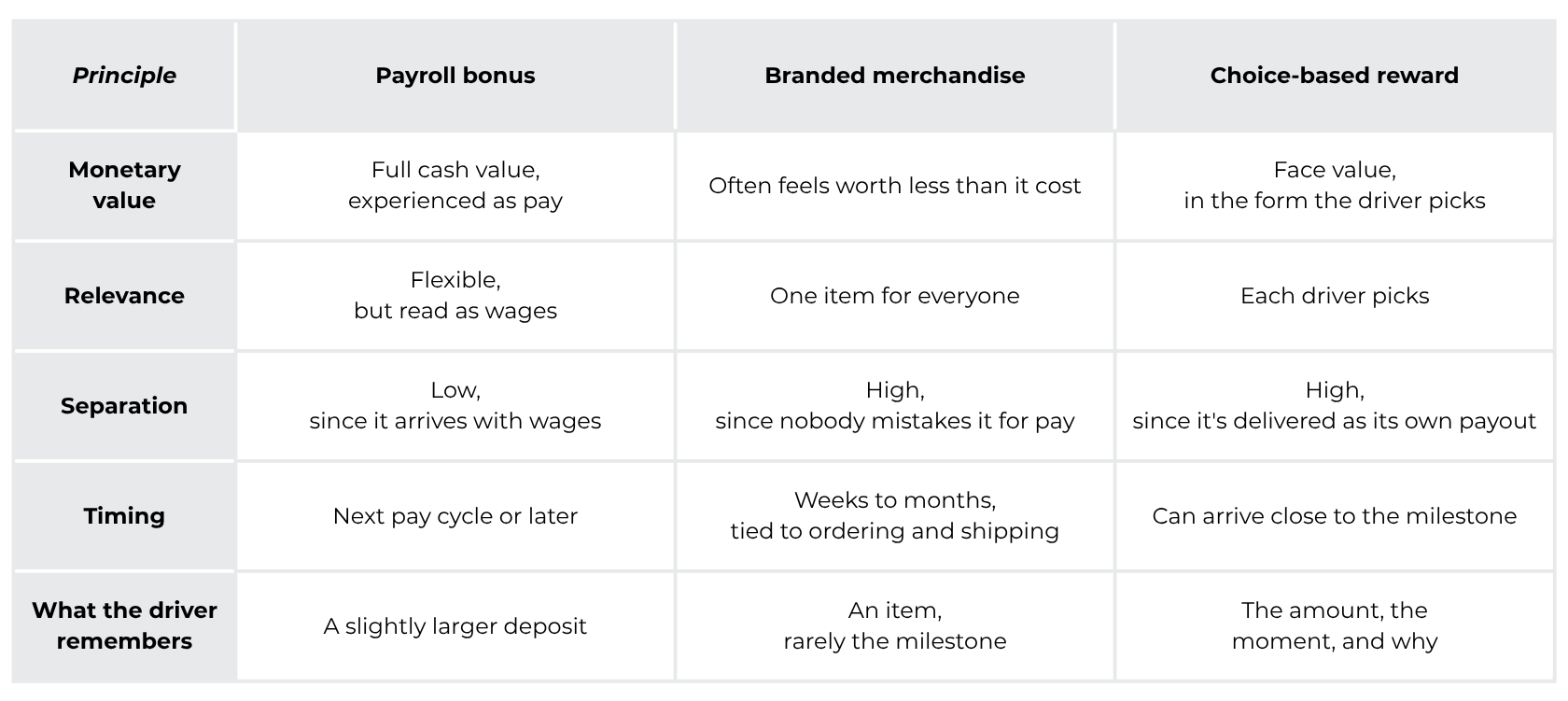
Why do branded merchandise and payroll incentives underperform?

Both channels are chosen with good intentions. Merchandise is tangible, easy to budget in bulk, and puts the company name in front of the driver. Payroll is simple because the process already exists. Scored against the four principles, though, each one leaves a gap.

There's also an operational gap that sits behind both channels. Most fleets capture driving behavior automatically, and the process tends to break down at the reward step. Someone is exporting scorecard data, cross-referencing HR records, ordering inventory, or building a payroll adjustment by hand. That work grows with every driver the fleet adds, and it's a big reason rewards arrive late.

Delivering choice can sound like a major build: a rewards platform, a points catalog, a redemption storefront, or a vendor project with a six-month timeline. In practice, the fleet has usually done the hard work already by defining the behaviors, instrumenting the trucks, and deciding what good driving is worth. What remains is the payout itself.

Start with a branded prepaid card. A prepaid card is the simplest form of choice a fleet can offer, because the driver decides what to spend it on. It covers the utility bill, the birthday gift, or the cab gear, and the fleet never has to guess. ChoiceCard can be issued as a physical or virtual card, spent anywhere Visa is accepted, and carry the fleet's brand. That branding does the job merchandise is trying to do. A logo jacket gets worn a few times and ends up in the laundry pile, while a branded card sits in the driver's wallet and brings the program back to mind every time it's used. Because the money arrives on its own card, apart from the paycheck deposit, it keeps the separation that makes it read as a reward.

Add payout choice with more payout options. The next step is letting drivers choose the form the money takes. ChoiceLink delivers a single branded link where the driver can pick from options the fleet has selected, such as PayPal, Venmo, a gift card to a brand they already shop, a prepaid card, direct deposit, or a check. The payout arrives as part of the fleet's program instead of as a payment from an unfamiliar vendor.

Connect it to the data the fleet already has. The scorecard already knows who earned what. An API, SFTP, or file-based integration can turn that signal into a funded, branded payout, so the program runs on existing data instead of a spreadsheet.

Once the payout is in place, four decisions determine whether the program reinforces driving behavior:

  1. Pay on the milestone: Trigger the reward when the driver hits the goal instead of waiting for a month-end batch, so it lands while the driver still remembers the week that earned it.

  2. Name the behavior in the payout: A short message such as "Q3: zero preventable incidents" attached to the reward is what connects the money to the milestone.

  3. Keep the options curated: A handful of different ways to take the money works better than an endless list.

  4. Choose a partner that delivers speed and choice: Look for a provider that can pay close to the milestone, offer a curated menu, and keep a record of who was paid, how much, and when, so no one on the team has to reconcile rewards by hand.

The fleets getting the most out of their safety and retention budgets usually aren't spending more than everyone else. They spend the same money on a reward the driver chose, delivered close enough to the behavior so they can connect the two, and kept separate from the paycheck so it registers as recognition.

Every reward a fleet gives is a chance to hand a driver one more reason to stay. Make every payout matter.

Is your reward getting lost in the closet, the paycheck, or the wait? Let's talk about what your driver incentive program could look like with choice-based rewards. Book a strategy call.

More to read