Choice Digital Launches the Choice Suite, Putting Payout Choice in Recipients' Hands

Learn more
Blog

How Many Payout Options Should You Offer Recipients?

By: Theresa McEndree, Chief Growth Officer at Choice Digital
How Many Payout Options Should You Offer Recipients?

Stop counting options

The right number of payout options isn't two, three, or five. It's the specific mix of methods that matches a payout's size and a program's goal. Get it wrong, and participation drops before a recipient ever makes a choice.

Most program owners think about coverage — add a rail, check a box, move on. But the data says something different: the number of choices can impact preference just as much as the choices themselves.

I’ve seen countless teams spend months debating whether to add a third or fourth method, then offer a mix without testing what sits next to what.
How do you let recipients choose how to be paid?

After analyzing redemption behavior from hundreds of live programs, we can confirm that preference moves with the amount.

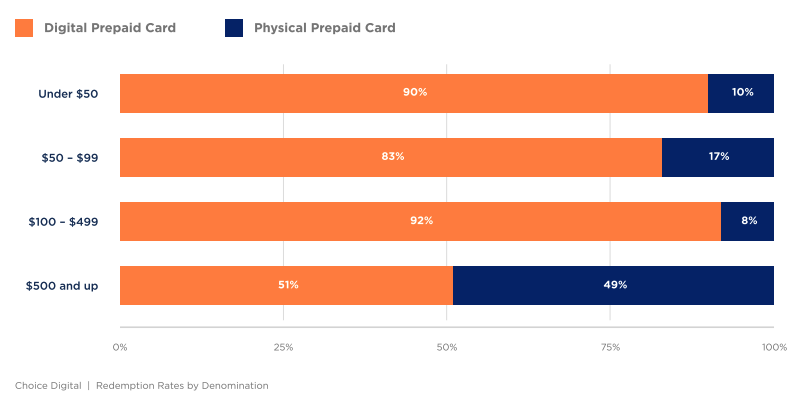
Offer only digital and physical prepaid cards, and digital takes 90% of choices under $50. That share holds above 80% all the way to $499. Cross $500, and it drops to 51%, an almost even split with physical.

A rebate paying $25 and a claims payout settling at $700 will not behave the same way on the same default. A digital-first default is right for the small, frequent payout and wrong for the large, infrequent one. Letting recipients choose how to be paid means letting the menu, not the operator, make that call.

Most default settings get built once, and never revisited as a program's payout mix shifts. A rewards program that starts at $15 average payouts and grows into $200 tier bonuses is still running the mix that was right for the smaller number. Nobody decided to keep it. Nobody decided to change it either.


Does adding payout options change participation?

Hold the payout size steady, and methods become the variable.

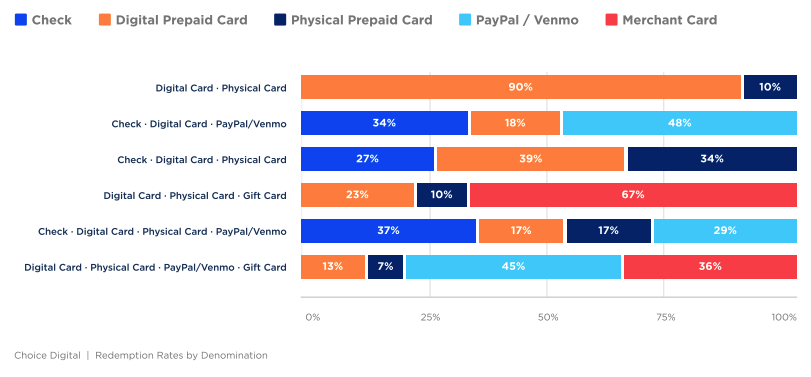
Look how the gift card behaves. Up against prepaid alone, it takes 67% of the choice. Add a wallet — same mix, same recipients, same payout amount — and the share falls by nearly half. Nothing about the recipient changed, just the options did.

This is the piece most programs get wrong. They assume more options add friction, so they ship the smallest mix they can defend internally. The evidence points the other way: 68% of recipients say they're more likely to participate in a program when they can choose how they're paid.


When choice is the strategy

The paradox of choice says more options paralyze people. In a grocery aisle, maybe, but not in a payout. Recipients already know how they want to be paid before they open the message. 

That reframes the whole question. It was never "how many payout options is too many"; it's "which two or three options actually match this payout." A $25 rebate and a $700 claim need different options. A digitally native audience and an underbanked recipient need different options.

The goal you're optimizing for changes the answer too. A mix built to maximize participation looks different from one built to minimize cost, and both look different from one built to reach a recipient that can't rely on a bank-transfer default. 

There is no universal best mix, only the right one for this payout, this amount, and this audience. Programs that treat payout options as fixed infrastructure are optimizing for the wrong thing, then wondering why participation is low.


Design a mix that delivers real choice

The number of options on your payout mix was never the point. What it's built from is. A program that offers three methods chosen from redemption data will outperform one that offers five chosen from habit.

So before the next program launches, the real question isn't how many options to add. It's which ones, at what amount, for which recipient, and whether anyone has looked at what they actually chose the last time.

Our team is here to guide you through the process. Let’s book a strategy call

More to read